
New Orleans Boat Accident Lawyer
If you are hurt while boating on Lake Pontchartrain, the Mississippi River, or nearby waters, you may recover medical costs, lost income, and compensation from whoever caused the accident. In Louisiana, boat accidents are fault cases. You have 2 years to file a claim. If the crash happened on navigable water, maritime law might apply. That can change your deadline, how fault is decided, and which courts hear your case.
The main question in every claim is whether the boat operator acted with reasonable care. Our New Orleans attorneys answer this question every day. You can start your claim with a free case review.
Get Hurt?
Get Rude®.
Tell us where to reach you.
A real person will call you back.

Lee Rudin, Esq.
Founding Attorney · Rudin Law
Who is liable in a boating accident
The negligent boat operator, the vessel’s owner, and the rental company that supplied the boat can be liable in a New Orleans boating accident. Negligence is a failure to use reasonable care. A Louisiana boat accident claim relies on ordinary negligence under La. C.C. art. 2315, not strict liability. A dog-bite claim can hold the owner strictly liable, but a boat case cannot. You must prove a duty of reasonable care, a breach, and causation linking that breach to your injury. The operator owes that duty to passengers, other boaters, swimmers, and everyone on the water.
Each type of defendant can be responsible for a different mistake, so we look at all three in every case.
- The operator: The person at the helm is responsible for careless speed, poor lookout, wake decisions, and impaired operation.
- The vessel owner: If the operator had the owner’s express or implied consent, the owner may be liable for injuries caused by the operator’s negligence, even if the owner was not aboard (La. R.S. 34:851.18). Handing the keys to a drunk or unqualified operator can also be negligent entrustment, the owner’s own fault in choosing that operator.
- The rental livery: A rental contract constitutes consent under the owner statute, so we argue the statute applies to a commercial livery. The livery’s skipped legal duties provide a second, stronger route for the claim.
Insurance companies often blame your actions and try to downplay the operator’s fault, focusing on things like your blood-alcohol level or whether you wore a life jacket. Louisiana law, however, focuses on whether the operator acted with reasonable care.
Two boundaries matter before going further. Injuries involving commercial vessels, docks, and harbor work belong with our commercial maritime injury claims. A crew member hurt working aboard a vessel has Jones Act claims for injured seamen instead of this recreational-claim path.
Drunk boating
Boating under the influence turns an ordinary boat accident claim into a stronger one. Louisiana’s impaired-operation statute, La. R.S. 14:98, expressly reaches watercraft, so operating a boat drunk is a crime here, the same way drunk driving is. In your civil claim, the operator’s violation becomes evidence of the breach, proof for the art. 2315 negligence case that wins you a recovery. The criminal prosecution and your civil claim run on separate tracks, and you don’t wait on the State to finish before filing yours. How the evidence is built and what the BAC record proves are the basis for our claims against a drunk boat operator practice.
Jet ski and personal watercraft accidents
Louisiana law sets specific rules for personal watercraft (PWCs/Jet Skis):
All riders must wear life jackets, operators must be at least sixteen, and rental companies must provide safety instructions and paperwork. If the rental company fails to perform any of these duties, it can be held liable for injuries. See our section on PWC rules for full details. (La. R.S. 34:855)
The livery’s duties start before the rental. Louisiana requires a motorboat livery to provide instruction, an LDWF-approved safety video, and the current rules publication as part of a signed rental contract (La. R.S. 34:851.36). A skipped duty is the livery’s own breach, not just the renter’s problem. The livery’s statutory duty to keep that rental contract in effect lasts only 60 days after the rental ends, so the paperwork documenting the instructions given can disappear quickly. A signed rental waiver does not save the livery either, because any clause that excuses liability for physical injury in advance is null under La. C.C. art. 2004.
The injuries themselves are distinctive. A rider thrown off the back of a PWC can suffer a jet-thrust hydrostatic injury, internal damage caused when the jet nozzle’s pressurized stream enters the body. The wound is internal, and an emergency room can underestimate it.
Propeller injuries
A propeller strike is usually preventable, making it a negligence case. The strike results from operator failure, such as poor lookout while swimmers were in the water, restarting the engine near the stern, or ignoring the engine cut-off lanyard, which is designed to kill the motor when the operator leaves the helm. Proving which failure occurred is the core of the claim. A spinning prop can cause traumatic amputation in under a second, and survivors face reconstructive surgery and prosthetic fitting for years.
A case cannot be valued until doctors know the final level of amputation, the prosthetic plan, and any future surgeries. Insurance companies know this, so their early offers reflect only what is known now, not the true long-term costs. A boat accident lawyer will document your entire treatment journey to ensure your claim covers all future expenses.
Common boat accident injuries
Drowning, propeller strikes, blunt-force trauma, and carbon-monoxide poisoning cause the most serious boating accident injuries on Louisiana waters. Louisiana logged 92 reported boating incidents in 2024, with 9 deaths and 65 people injured (USCG Recreational Boating Statistics 2024, Table 30). Lake Pontchartrain solely accounted for roughly 138 reported accidents, 66 injuries, and 32 deaths from 2005 through 2024, the most reported of any Louisiana water body (USCG Boating Accident Report Database).
Non-fatal drowning and brain injury
Drowning is a single process of respiratory impairment from submersion, with fatal and non-fatal outcomes. A survivor can carry hypoxic-ischemic brain injury, lasting damage from oxygen loss that can mean lifelong cognitive and care needs.
PWC jet-thrust internal injury
Internal injuries caused by the jet nozzle’s pressurized stream are hard to detect and easy to undervalue in an early offer.
Blunt-trauma TBI and spinal injury
Traumatic brain injury and spinal damage from collisions or ejections can take months to declare their full extent.
Carbon-monoxide poisoning
Standard pulse oximetry readings may be falsely normal, so CO-oximetry is needed to document the exposure for the claim.
Hypothermia
Time in the water while waiting for rescue complicates every other injury and documents how long the victim was left exposed.
Serious boat accident injuries in this area are treated at state-designated trauma centers, which have different levels. In New Orleans, there are the University Medical Center (Level I Trauma Center) and Manning Family Children’s (Level I Pediatric Trauma Center). Baton Rouge has Our Lady of the Lake Regional Medical Center (Level I Adult Trauma Center) and Our Lady of the Lake Children’s Hospital (Level II Pediatric Trauma Center). On the Northshore, Covington has Lakeview Regional Medical Center (Level II Trauma Center) and St. Tammany Parish Hospital (Level III Trauma Center). The hospital where you received treatment becomes important evidence in your case.
Doctors track recovery to maximum medical improvement (MMI), the point at which your condition will not improve with further treatment. Neurological recovery and prosthetic fitting take time to reach that point, which is why an early settlement offer undervalues a serious boating injury.
Boating safety rules and the standard of care on Louisiana waters
A violation of a boating safety rule can be evidence of negligence under the duty-risk analysis, the framework that Louisiana courts use to determine fault. That makes the state’s boating rules the standard of care for your boat accident claim. The violation never wins the case on its own. Louisiana rejects standalone negligence per se (Faucheaux v. Terrebonne Consol. Gov’t, La. 1993), so we pair the broken rule with the art. 2315 negligence claim, using the violation to prove the operator’s breach rather than treating it as automatic liability.
The numbers show why these rules exist. Of Louisiana’s 87 boating fatalities from 2021 through 2025, 81 percent were not wearing a life jacket, and 75 percent had never taken a free boating-education course (LDWF, May 14, 2026 release). Operators born after January 1, 1984, must complete that course before running a motorboat over ten horsepower. You can get Louisiana’s boating rules explained in our standalone guide, from registration to navigation lights. What matters here is narrower. The required safety equipment rules are the ones that support the duty-risk proof in a boat case.
Required safety equipment
Louisiana requires a personal flotation device for every person aboard, and anyone sixteen or younger must wear one while on a boat under 26 feet that is underway (La. R.S. 34:851.24). The operator, not the passenger, is legally responsible for life-jacket violations. The same statute requires navigation lights, sound-signaling equipment, and fire extinguishers, which vary by vessel size.
If a boat operator allowed passengers to ride without life jackets, operated at night without lights, or lacked fire equipment, they broke the law. This violation can be used as evidence of negligence. If you did not wear a life jacket, it may reduce your recovery, but does not prevent you from making a claim.
Does maritime law or Louisiana law govern your boat accident
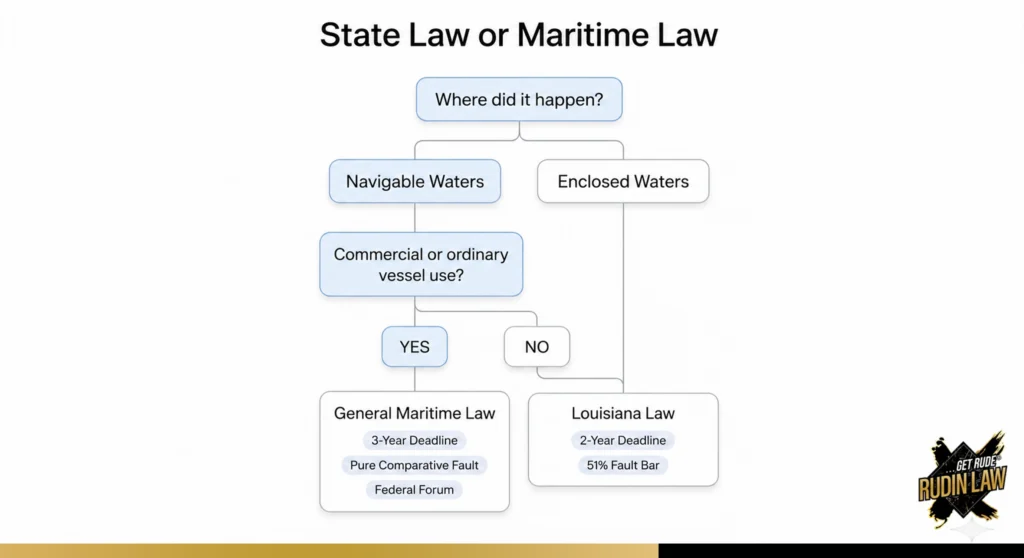
Where your boat accident happened and whether it has a connection to maritime activity, decide which law governs. The answer changes your filing deadline, your fault rule, and the courts available to you. General maritime law, the federal law of navigable waters, applies when both conditions are met (Grubart v. Great Lakes Dredge & Dock Co., U.S. 1995). Recreational boats qualify. The U.S. Supreme Court held so in a case about a pleasure-boat collision on Louisiana’s Amite River (Foremost Ins. Co. v. Richardson, 1982). The maritime nexus reaches weekend boaters, not just oil rigs and cargo ships.
The table below compares the deadline, the fault rule, and the forum under each body of law.
| Question | Louisiana law | General maritime law |
|---|---|---|
| Filing deadline | Two years for injuries on or after July 1, 2024, one year for earlier injuries | Three years from the injury |
| Fault rule | 51% bar for accidents on or after Jan. 1, 2026, pure comparative fault earlier | Pure comparative fault, any share of fault reduces but never bars recovery |
| Forum | Louisiana state court | Federal court, or state court under the saving-to-suitors clause |
The state deadline is set by La. C.C. art. 3493.1 and the maritime deadline by 46 U.S.C. § 30106. Pure comparative fault applies whenever general maritime law governs, regardless of accident date. Around New Orleans, courts have treated the Mississippi River, Lake Pontchartrain, and the Gulf Intracoastal Waterway as navigable waters within admiralty, while the 17th Street, Orleans Avenue, and London Avenue outfall canals have been held not navigable.
Maritime law also gives the vessel owner a way to limit liability that most boaters do not know about. Under the Limitation of Vessel Owner’s Liability Act, an owner can file a federal petition to cap total exposure at the vessel’s value plus pending freight (46 U.S.C. § 30523) and must do so within six months after written notice of a claim (46 U.S.C. § 30529). A well-drafted notice letter starts that six-month clock running against the owner, which is why the jurisdiction question gets answered early in our cases.
Watercraft insurance and the uninsured boat owner
The responsible party’s watercraft or marine liability policy usually pays a boat accident claim. Louisiana requires no liability insurance to own or operate a recreational boat. The state registered 286,912 recreational vessels in 2024 (USCG Recreational Boating Statistics 2024, Table 38) with no coverage requirement.
Most of the time, there is still coverage. Many boat owners buy watercraft insurance on their own, and sometimes a homeowner’s policy covers small, low-power boats. We always check the policy details to confirm. If insurance applies, the company will usually defend the claim but may still argue that the policy does not cover the loss.
The uninsured boat owner is the hard case. With no coverage mandate, an uninsured owner’s recovery is limited to the owner’s personal assets, other liable parties, such as a livery, or the injured person’s own coverage. Identifying every policy early sets the ceiling on what you can collect.
How much is a New Orleans boat accident claim worth? The factors that decide it
The value of a New Orleans boat accident claim depends on how serious the injury is, what insurance is available, how fault is divided, and where the case is filed. There is no set formula, and a trustworthy lawyer will not give you a number before reviewing your records.
- Injury catastrophe: A non-fatal drowning brain injury, a traumatic amputation, or a death sits at the top of the range. Lifelong care needs weigh more heavily than any other factor, and we pair those cases with representation in a life-changing boating injury case.
- Available coverage: A watercraft or marine policy means there is money to pay the claim. An uninsured boat owner limits what you can collect.
- Comparative fault: Every percentage point of fault assigned to you reduces the recovery under La. C.C. art. 2323, and for accidents on or after January 1, 2026, a share of 51 percent or more bars it entirely. Under maritime law’s pure comparative rule, your share reduces but never bars.
- Punitive availability: Whether punitive damages are available against a drunk operator remains an open question in Louisiana, to be determined on a case-by-case basis.
- Venue: Where the case can be filed shapes how it gets valued.
Insurance companies often focus on comparative fault. They may point out that you were not wearing a life jacket and claim that your actions caused your injuries. Louisiana law handles this in two ways: your awareness of the risk is just one factor and does not automatically prevent recovery (Murray v. Ramada Inns, La. 1988), and the missing life jacket only matters if it would have prevented your injury.
Damages fall into two groups. Economic losses are the bills and lost income. General damages include pain and suffering. Pain and suffering are proven with treatment records, testimony, and the documented arc of your recovery.
Our boat accident claim process

Our firm runs every boat accident claim on the R-U-D-E method, proving the operator’s negligence and holding them accountable from intake through resolution.

R
Research
We secure the crash report, toxicology records, life jacket status, vessel registration, and rental paperwork before the evidence disappears. Preservation letters go out immediately.

U
Understand
We determine whether maritime or Louisiana law governs, follow your medical care to maximum medical improvement, and identify every liable party and policy.

D
Develop
We build demand around what the records prove, matching each instance of damage to documented losses. The demand goes out when the proof is ready, not when the adjuster asks.

E
Execute
We negotiate the demand with the insurer. If they do not pay what the records support, we will file suit and walk you through what filing a Louisiana personal injury lawsuit entails.
Frequently asked Questions about Boat accident in New Orleans
Do I need a lawyer for a boating accident?
Yes, you should hire a lawyer if your injuries are serious or if there are questions about which law applies or what insurance is available. Boat accident cases can depend on whether maritime or Louisiana law applies, and a vessel owner can file a Limitation Act action within six months. If you wait without a lawyer, important deadlines keep running, rental paperwork can be lost, and the owner’s legal filing could limit the money available for your claim.
Is a boat accident a maritime case or a Louisiana case?
It depends on whether the accident occurred on navigable waters and whether it is connected to maritime activity. Recreational boats can qualify. State law gives a two-year deadline and applies the 51% fault bar. Maritime law provides a 3-year statute of limitations and uses pure comparative fault. No one can tell you which law governs without your facts, which is part of the first case review.
Can I sue a drunk boat operator?
Yes. Louisiana’s impaired-operation statute, La. R.S. 14:98, expressly covers watercraft, and the operator’s violation becomes evidence of breach in your civil negligence claim under art. 2315, which runs separately from the criminal case. Whether exemplary damages reach a drunk boater is an open question in Louisiana courts, so we plead them where the facts support them and never promise them. You can start by suing the impaired boat operator while the criminal case proceeds.
Whose insurance pays for a boat accident?
The responsible party’s recreational watercraft or marine liability policy usually covers the loss. A homeowner’s policy sometimes extends to small, low-power boats, which must be confirmed in the policy itself. Louisiana requires no boat liability insurance at all, so an uninsured boat owner is a real risk, and finding every policy that touches the crash, including your own, is one of the first jobs in the claim.
Can my family sue if someone died in a boating accident
Yes. Louisiana gives the family one year from the death or two years from the injury to file (La. C.C. art. 2315.2(B)), and the federal Death on the High Seas Act applies only to deaths beyond state waters (46 U.S.C. § 30308(b)). The firm brings wrongful death claims for Louisiana families after a fatal boating accident, with their own deadlines and their own set of eligible family members.

The lawyer behind GET RUDE®
Lee Rudin
Owner & Attorney · Louisiana Bar, 2012 · Texas Bar, 2024
If you are dealing with an insurance company after a boat accident, it helps to have a lawyer who has worked with them. Lee Rudin defended insurers and corporations at three Louisiana firms from 2012 to 2023 before starting this firm. He understands how insurance companies build their cases, including common defenses like the life-jacket argument and comparative fault. Lee is personally involved in every case, from your first call to the final resolution.
Rated & recognized


National Institute for Trial Advocacy

State Bar of Texas

Louisiana State Bar Association

Louisiana Association for Justice

Super Lawyers
No Fee Unless You Win
Get A Free Case Review Today! Call (504) 500-5504


No Fee Unless You Win
Get A Free Case Review Today! Call (504) 500-5504
CLIENT REVIEWS









Contact Rudin Law
Uptown New Orleans Office
We proudly serve all of New Orleans, including Uptown New Orleans and the surrounding neighborhoods, such as Broadmoor, Central City, the Garden District, the 7th Ward, and Treme.
Recent Blogs
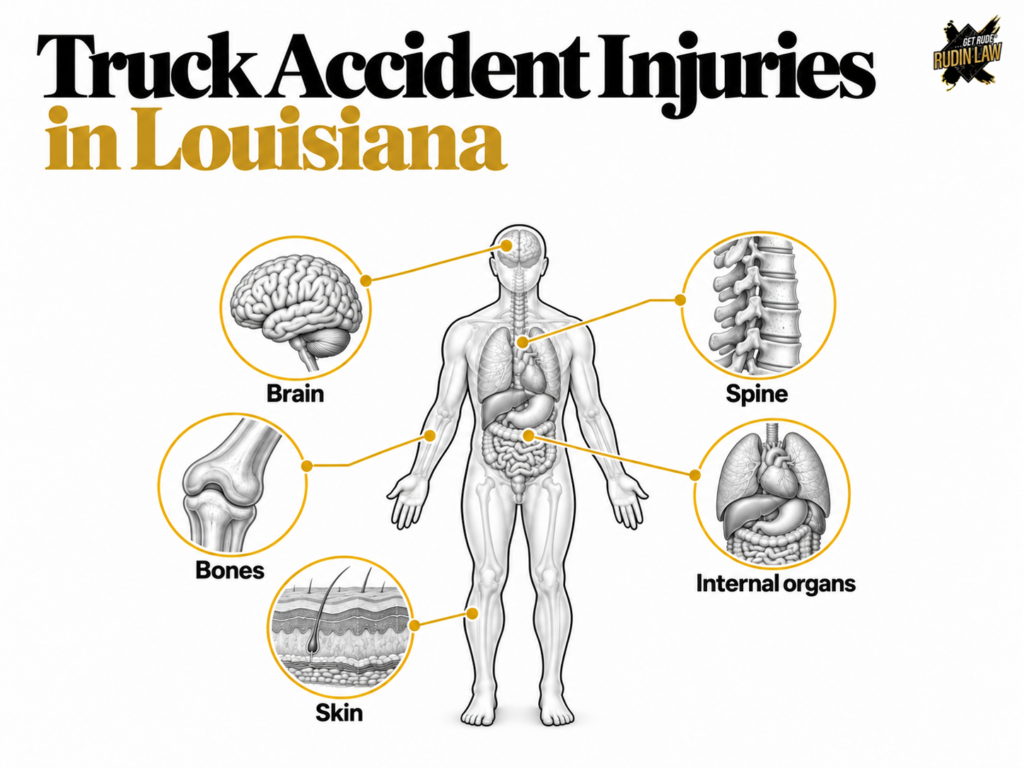
Common Truck Accident Injuries in Louisiana
Truck accident injuries happen when a commercial truck hits you or your car. The truck’s size and weight make those injuries worse. Maybe you’re the…
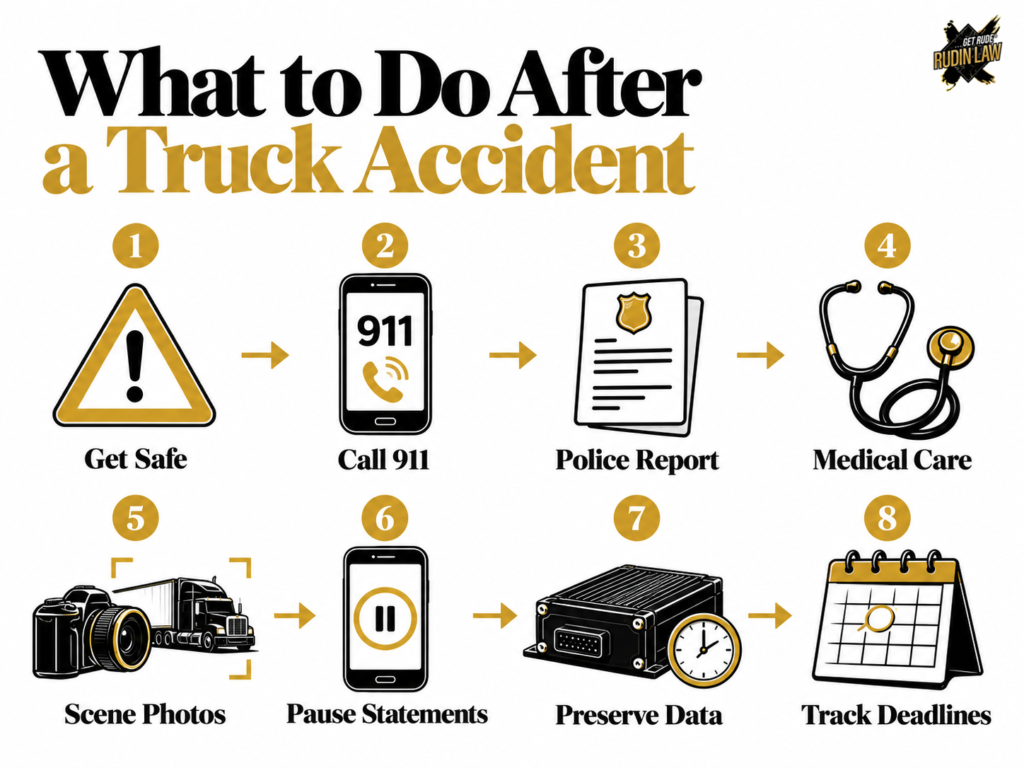
What to Do After a Truck Accident
What you do in the first few days after a truck wreck can shape your claim. What you say and what you keep to yourself…
Tanker Truck Accident Lawyer in New Orleans
What a tanker or fuel truck carries can make your injuries from a New Orleans crash far worse. Fuel and chemicals can catch fire or…